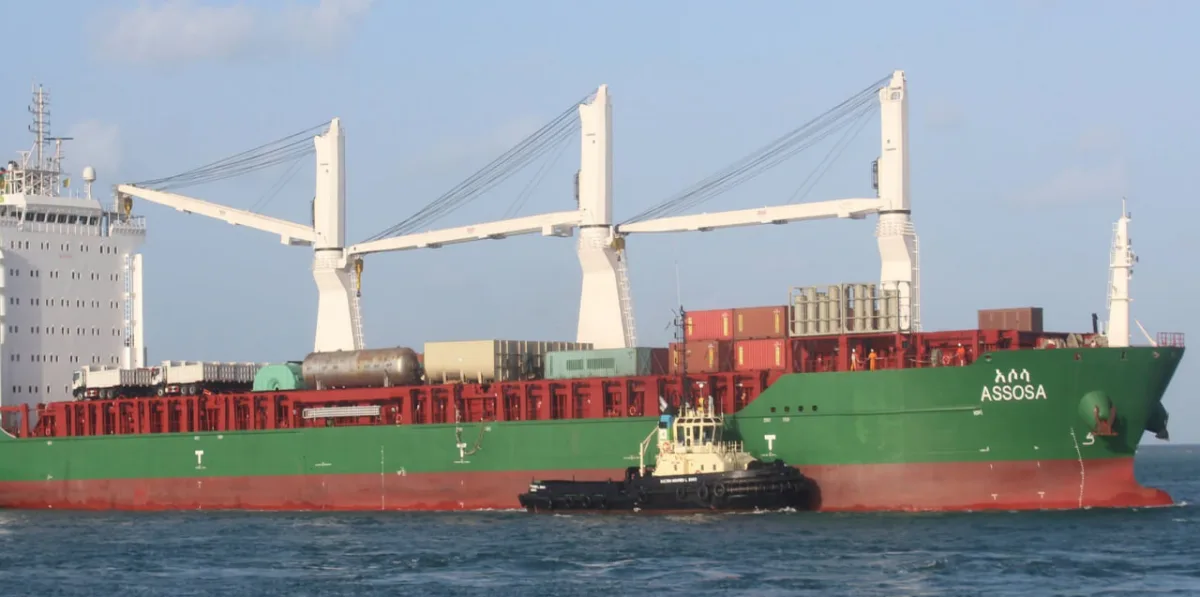
At a time when the escalating geopolitical crisis in the Middle East poses a significant security threat to international maritime transport and vital trade routes, it has been reported that the Ethiopian Shipping and Logistics-owned vessel, "Assosa," has made history by successfully completing its mission.
Despite the high security risks due to the tensions in the region, the Ethiopian vessel "Assosa" successfully navigated all challenges to reach the strategic port of Khor Fakkan, located in close proximity to the Strait of Hormuz.
The vessel was carrying cargo critical to Ethiopia's social and economic activities, including medical supplies, medicines, and various commercial goods. After successfully loading these goods, the ship was able to return safely to the port of Djibouti—a neighboring country and Ethiopia's main gateway to the sea—with great caution and professional competence.
The institution stated that this success is a historic milestone that demonstrates the reliability and partnership of Ethiopian Shipping and Logistics. It further noted that the achievement validates the commitment of our seafarers and the competence of Ethiopia's maritime logistics.
Previously, the institution had announced that the vessel was navigating international oceans, strengthening connections from deep-sea ports in Northern Europe to global trade routes, and supporting international trade worldwide.
The Strait of Hormuz is known to be an extremely narrow but globally recognized strategic maritime transit route located between the Persian Gulf and the Gulf of Oman. As one-third of the world’s total oil and petroleum product shipments pass through this route, it is considered the backbone of the global economy and the international supply chain.
However, due to the war-related tensions in the area, navigating the Strait of Hormuz and nearby port zones, such as Khor Fakkan, has become a task requiring strict international diplomatic coordination.
Furthermore, the institution announced that it has unveiled a grand plan to purchase 16 new vessels over the next five years to strengthen its position in international maritime trade and logistics.
Currently, vessels flying the Ethiopian flag are effectively operating on international routes, leveraging the country's growing diplomatic relations.
The institution currently manages 10 owned vessels, nearly 60 chartered vessels, and additional slot-sharing agreements, enabling it to reach over 370 ports around the world.