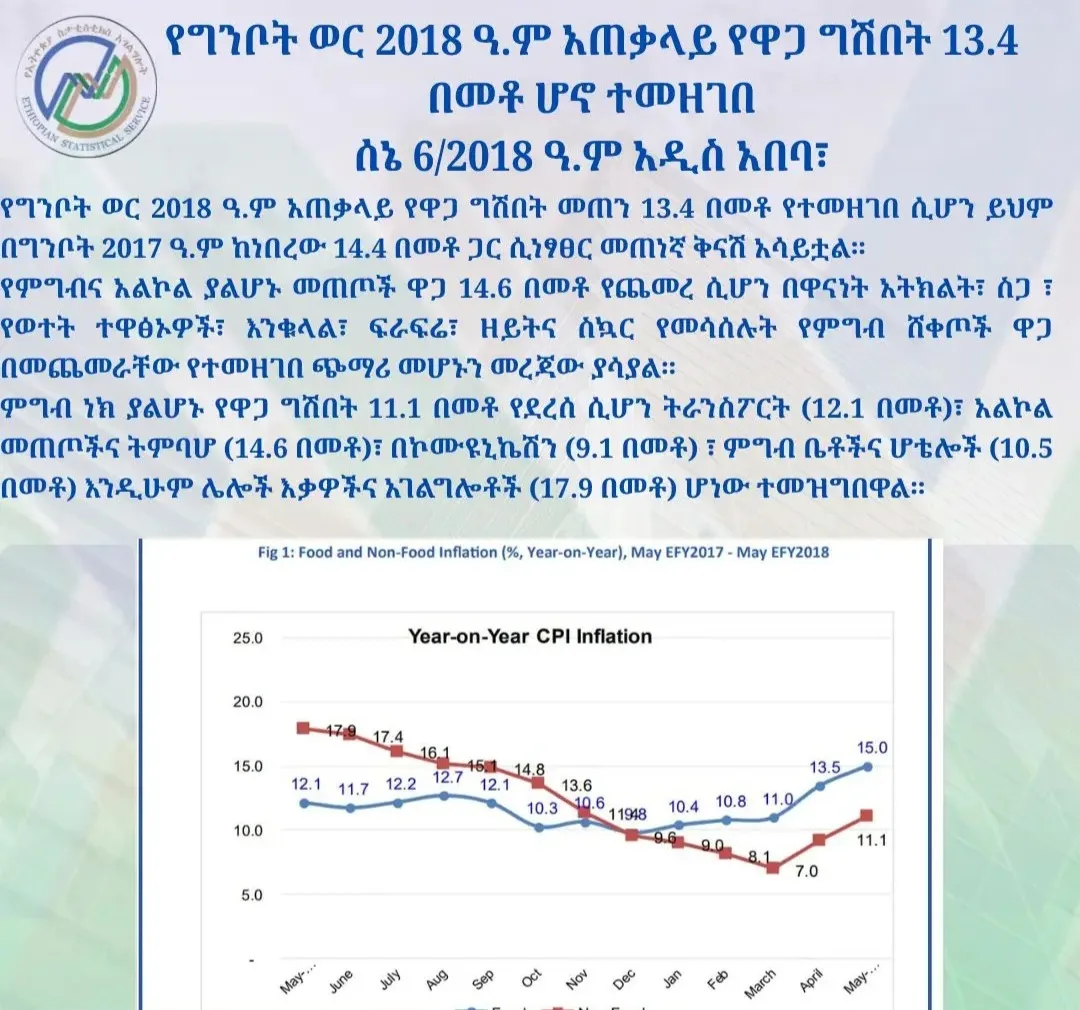
According to the official statement released by the Ethiopian Statistics Service, the headline inflation rate for the month of May 2018 E.C reached 13.4 percent.
Although this figure shows a slight decline compared to the same month last year, the 14.6 percent increase in food prices continues to place significant pressure on the purchasing power of citizens.
The inflation is primarily driven by the persistent rise in the costs of essential food items, including vegetables, meat, dairy products, eggs, fruits, edible oil, and sugar.
Economic trends indicate that headline inflation climbed from 11.7 percent in April to 13.4 percent in May, highlighting that the rising cost of living is becoming increasingly challenging, particularly for low-income segments of the population.
In the non-food sector, inflation was recorded at 11.1 percent. A breakdown of these services and goods shows that transportation increased by 12.1 percent, while alcoholic beverages and tobacco rose by 14.6 percent.
Similarly, housing, water, electricity, and fuel services saw a 9.1 percent increase, and restaurants and hotels recorded a 10.5 percent rise.
Additionally, other goods and services experienced a 17.9 percent increase in price during the month.
The service's data indicates that inflation has shown volatility over the past year.
Even though the overall inflation rate has decreased compared to the same period last year the surge in food prices has pushed the cost of daily essentials higher, exacerbating the cost-of-living crisis.
This issue of inflation, which has been a growing concern in daily life and remains a long-standing challenge without a definitive solution, has particularly frustrated low-income households and those without fixed incomes.
Experts suggest that relevant government bodies must work with commitment to create market stability and control food prices.
However, the government maintains that it is making efforts to curb inflation by primarily restricting money circulation and tightening credit supply, controlling currency printing, and addressing supply shortages by increasing agricultural productivity.
Furthermore, the government states in its announcements that it is implementing strict oversight and market stabilization measures to curb unjustified price hikes caused by intermediaries and to control illegal hoarding by shortening the product marketing chain.
The monthly data released by the Ethiopian Statistics Service will serve as a crucial input for the government in its efforts to alleviate the cost-of-living crisis and in making economic decisions.