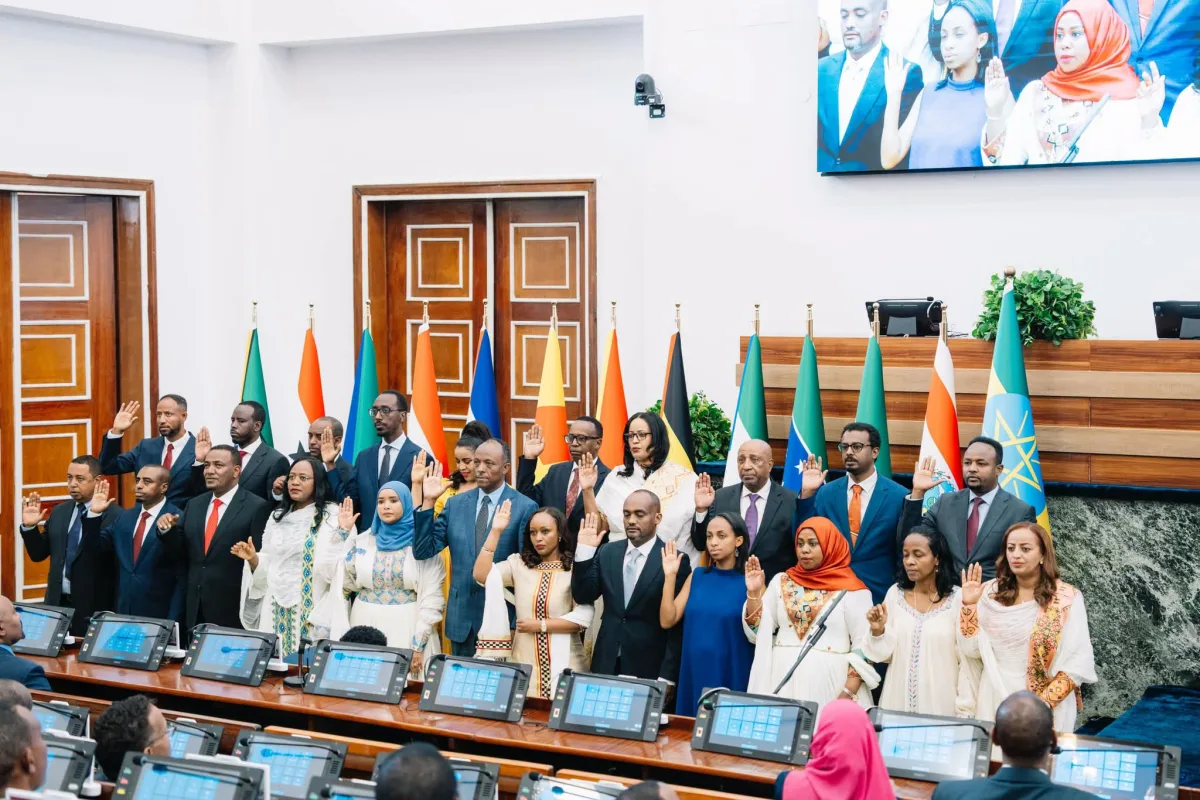
Prime Minister Dr. Abiy Ahmed formed his new cabinet today during the 1st regular session of the 1st year of the 7th House of Peoples' Representatives, held on Meskerem 28, 2019.
Out of the 23 ministers nominated and approved, nine officials have been retained in their positions, including Temesgen Tiruneh, who was appointed as Deputy Prime Minister.
Among those retaining their portfolios are Professor Berhanu Nega (Minister of Education), Dr. Gedion Timothewos (Minister of Foreign Affairs), Adisu Arega (Minister of Agriculture), Hanna Arayaselassie (Minister of Justice), Dr. Habtamu Itefa (Minister of Water and Energy), Dr. Mekdes Daba (Minister of Health), Aynalem Nigussie (Minister of Revenues), and Samrawit Kassa (Minister of Culture and Tourism).
Several new figures and leadership shifts across various ministries were also approved. Dr. Fitsum Asfa, formerly the Minister of Planning and Development, was appointed as the new Minister of Finance, succeeding the former minister.
Additionally, outgoing Peace Minister Mohamed Idris was appointed as the Minister of Defense, taking over from Aisha Mohamed. Meanwhile, former Culture and Sports Minister Shewit Shanka was assigned as the Minister of Women and Social Affairs.
New appointments to key portfolios include Yasmin WahabRebi formerly State Minister of Revenues taking over the Ministry of Trade and Regional Integration from Dr. Kassahun Gofe.
Frehiwot Tamru, who served long-term as the Chief Executive Officer of Ethio Telecom, was approved as the Minister of Innovation and Technology. Dr. Fiseha Yitagesu, former CEO of EBC, was appointed Minister of Industry.
Engineering professional Eng. Mohamed Abdurahman succeeded Chaltu Sani as the Minister of Urban and Infrastructure development following her recent appointment as CEO of the Federal Housing Corporation.
Furthermore, former State Minister of Planning and Development Bereket Fissehatsion were appointed to the newly established post of Minister of National Strategy. Sadat Nesha was named Minister of Logistics, and Alemtsehay Paulos assumed the post of Minister of Mines.
Other newly approved appointments include Awlu Abdi, former Deputy Chief Administrator of Oromia Region, as Minister of Work and Skills; Mussa Adem as Minister of Peace; Dr. Eng. Sultan Wali as Minister of Irrigation and Lowlands; and Dr. Aklilu Tadesse as Minister of Youth and Sports.
Explaining the selection process, Prime Minister Abiy Ahmed noted that the cabinet formation factored in gender, ethnicity, and religious representation, with women accounting for nine of the appointed ministers.
The Prime Minister stated that in forming the cabinet, efforts were also made to align educational backgrounds with executive capacity. He highlighted work experience, proven past results, and high performance as key criteria to identify individuals capable of delivering results over the coming years.
"Power is like a hat! It is not a head. At any time, unless the sun beats down or it is needed, it can be removed or set aside with honor. Therefore, we must be servants; both our hands and our hearts must be clean," the Prime Minister urged during the session.